construction timecard software
Construction Timecard Software Tied to the Job Record
Updated July 2026
Construction timecard software replaces the Monday-morning pile of paper cards with structured field entry: hours against cost codes per job, overtime computed, and an approval workflow before payroll. In Gradelog, timecards live on the same job record as the daily report and production quantities — so labor hours, work performed, and placed quantities reconcile instead of living in three systems.
Paper timecards fail quietly: unreadable entries, hours coded to the wrong job, OT surprises at payroll, and no way to connect labor to production. Standalone time apps fix the paper but create a new silo the office has to reconcile against everything else.
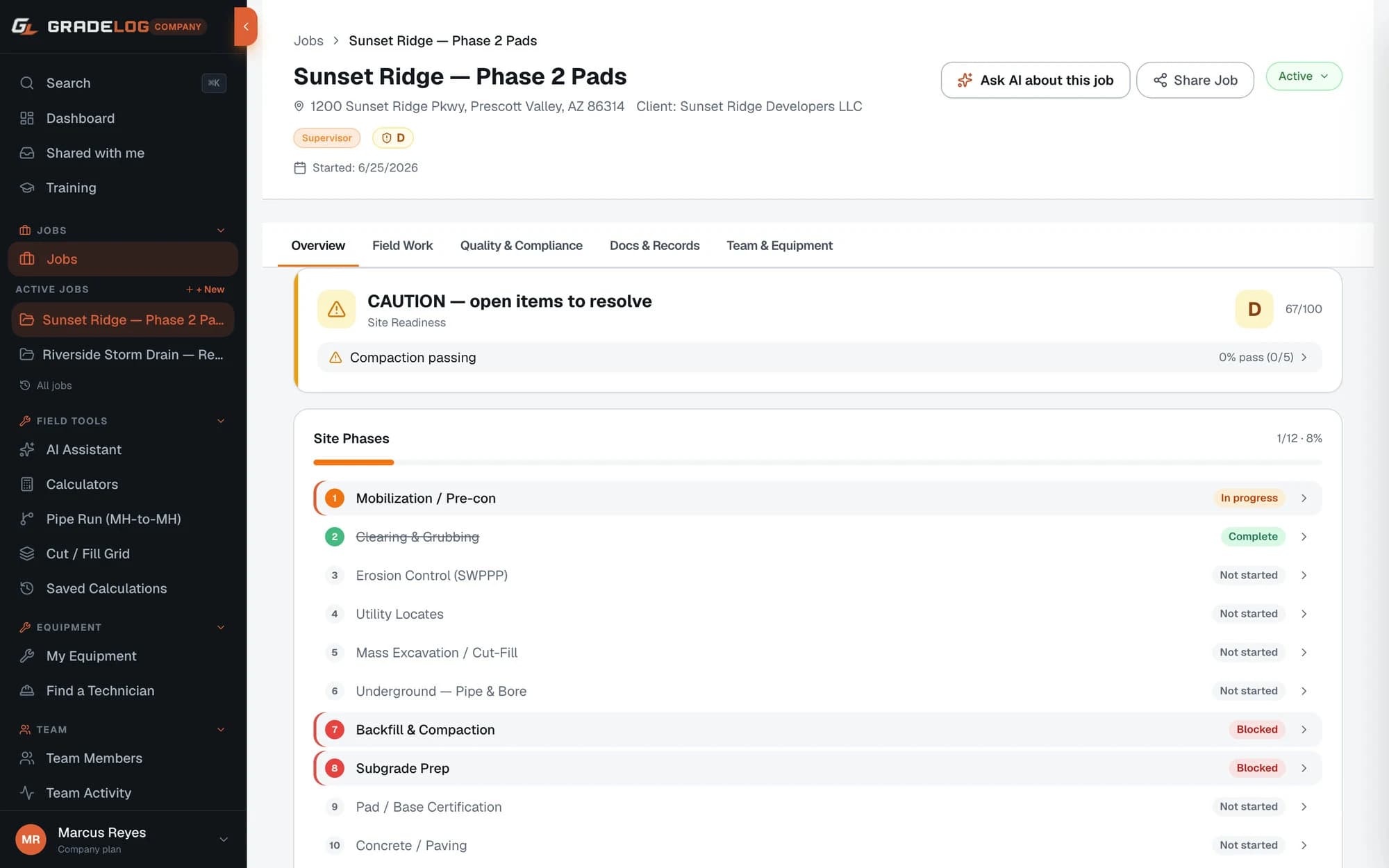
Gradelog treats time as part of the field record. The crew logs hours against jobs and cost codes; the foreman approves; payroll exports clean data. Because timecards sit beside the daily report and the production log, "who worked, what got built, and what it cost in hours" is one view — not a reconciliation project.
Who this is for
- Foremen collecting crew hours in the field
- Payroll admins tired of deciphering paper cards
- Companies coding labor to jobs and cost codes
- Contractors connecting labor hours to production
Hours, cost codes, and OT — entered where the work happened
Crew hours log per job with cost codes, and overtime rules compute automatically. Entries are timestamped and tied to the person, so the record is defensible in wage disputes and audit-ready for certified payroll workflows.
Approval before payroll, not after
The approval workflow routes timecards to the supervisor before they reach payroll. Corrections happen when memory is fresh — not two weeks later against a paycheck complaint.
Labor next to production: the number that matters
Because hours and placed quantities live on the same job, unit labor productivity is visible day by day. When hours climb and quantities do not, the job page shows it — the earliest possible warning that a crew, an area, or a bid assumption is off.
What's included
Timecards per job with cost codes
Overtime tracking and computation
Supervisor approval workflow before payroll
Timestamped, per-person entries
Same job record as dailies and production
Works offline in the field
Export for payroll processing
Role-based permissions on company plans
See it with real project data
Open the live demo — a fully seeded project you can explore without creating an account.
Frequently asked questions
Does it replace my payroll system?
No — it replaces the collection layer. Approved hours export cleanly for your payroll processor; what disappears is the paper card, the illegible handwriting, and the re-keying.
Can crews code time to specific cost codes?
Yes. Hours log against job and cost code, so labor lands where estimating and job costing expect it — per line item, not one lump per week.
How does overtime work?
OT tracks per person per period and is visible before approval — so the foreman sees the overtime picture while there is still a chance to manage it, and payroll never gets surprised.
What stops an employee logging hours they did not work?
Entries are timestamped, attributed, and routed through supervisor approval before payroll. The approval step — by someone who was on the job — is the control, backed by an audit trail.
Why keep timecards in the same app as field documentation?
Because labor only means something next to output. Hours beside daily reports and production quantities turn timecards from a payroll chore into productivity data — and it is one less app for the crew to learn.
Go deeper
Log it. Prove it. Build with confidence.
Free plan available. Works offline. Cancel anytime — your data is never deleted.