compaction test log software
Compaction Test Log Software for Nuclear Gauge Crews
Updated July 2026
Compaction test log software records each density test against the Proctor reference and computes percent compaction and pass/fail automatically. Gradelog logs nuclear gauge tests lift by lift with GPS location, dry density, moisture, and the spec requirement — and generates the compaction test report that shows the engineer every lift met spec before the next one went down.
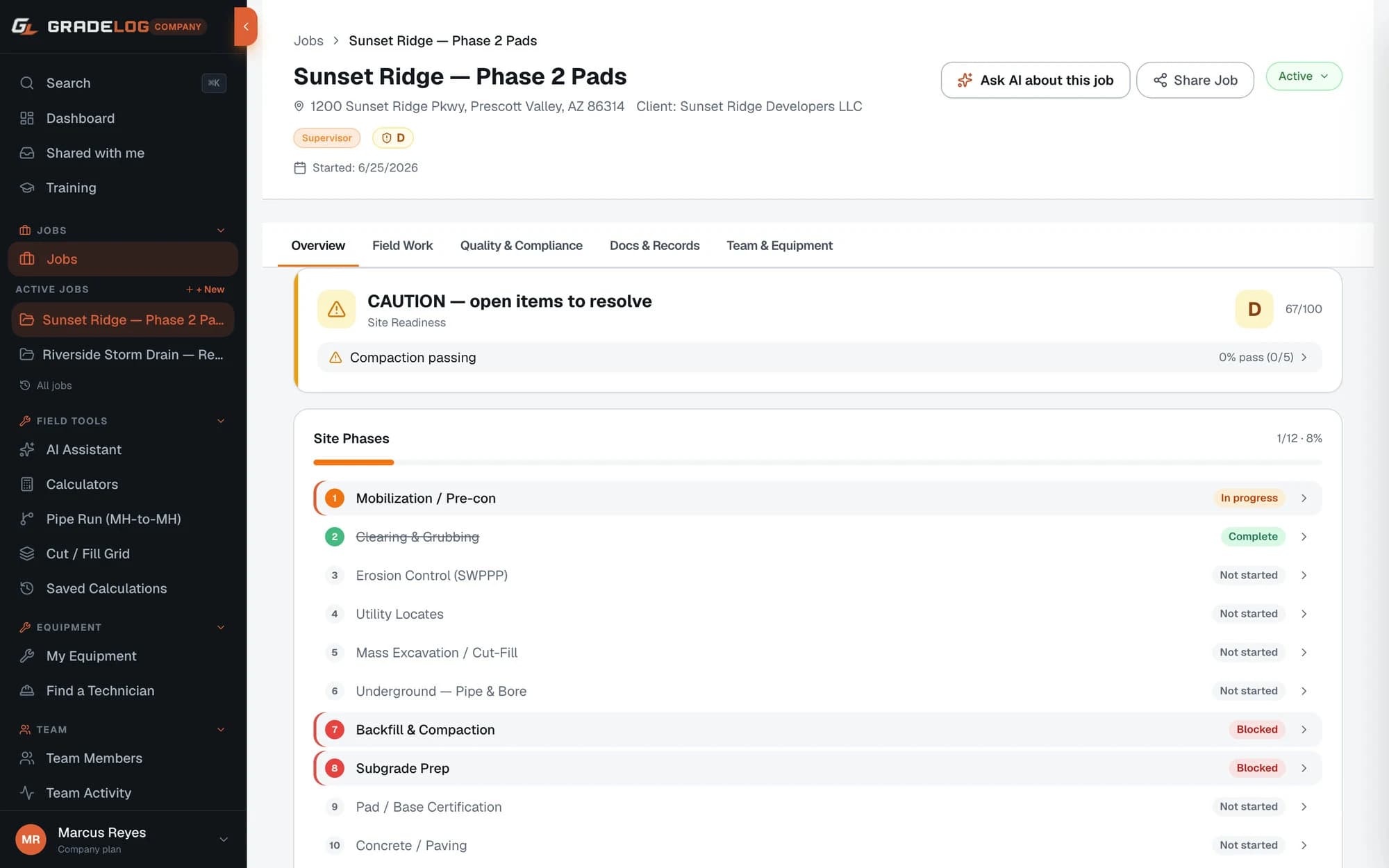
Failed compaction discovered after three more lifts went down is one of the most expensive mistakes on a dirt job. The paperwork side is how it happens: tests scribbled in a notebook, percent compaction worked out later, nobody certain which lift a number belongs to.
Gradelog structures the record at the moment of the test: gauge reading, moisture, dry density, the governing Proctor, computed percent compaction, pass/fail against spec, GPS location, lift and elevation. The engineer can see results as they sync — and the compaction report at the end of the phase assembles itself.
Who this is for
- Earthwork contractors running their own nuclear gauge
- Utility crews documenting trench backfill compaction
- Road and pad builders with lift-by-lift spec requirements
- Superintendents coordinating with third-party testing firms
Percent compaction computed, not hand-calculated
Enter the gauge reading; Gradelog computes percent compaction against the assigned Proctor automatically and flags pass or fail against the spec requirement (90%, 95%, whatever the section calls for). No evening math, no transposed densities, no ambiguity about which Proctor governed which area.
Lift-by-lift, location-by-location traceability
Each test records its lift, elevation, station or GPS position, and material. When an area fails, the record shows what was re-worked and re-tested — the retest chain lives with the original failure. Six months later, when a settlement question comes up, the entire compaction history for that structure is one search away.
Reports the geotech and the city both accept
The compaction test report compiles tests by area and lift with the Proctor references, pass/fail summary, and gauge details — exportable as a branded PDF or shared as a link. Trench backfill documentation for utility work follows the same record, tied to the same job as the pipe as-built.
What's included
Automatic percent compaction against assigned Proctor
Pass/fail against the spec requirement per area
Lift, elevation, station and GPS on every test
Retest chains tied to the original failed test
Nuclear gauge details logged per test
Compaction test reports as PDF or share link
Same job record as grade shots and as-builts
Offline capture for remote sites
See it with real project data
Open the live demo — a fully seeded project you can explore without creating an account.
Frequently asked questions
How does the software calculate percent compaction?
Percent compaction = field dry density ÷ Proctor maximum dry density × 100. You assign the governing Proctor (standard or modified) to the job or area once; each test then computes automatically from the entered dry density.
Does it replace the third-party testing lab?
No — where the spec requires independent testing, the lab still tests. Gradelog is the contractor’s own record: it documents your QC tests, tracks what passed before the lab arrived, and prevents the surprise failures that stop work.
Can it document trench backfill compaction for utility work?
Yes. Trench backfill tests log by station and lift along the run, in the same job record as the pipe as-built — a complete underground package for the city inspector.
What compaction test methods does it support?
Nuclear gauge density testing against standard or modified Proctor references. Test records include moisture content, dry density, and gauge identification.
Can the engineer see results the same day?
Yes. Tests sync as they are logged, and report links open without an account — the geotech can watch lift acceptance in near real time instead of waiting for a weekly PDF.
Go deeper
Log it. Prove it. Build with confidence.
Free plan available. Works offline. Cancel anytime — your data is never deleted.