Compaction Log · Road & Highway
Road Compaction
Log
Document nuclear gauge compaction tests for road subbase and base course against DOT specifications — station by station, lift by lift. AASHTO-formatted reports for inspector acceptance.
What it does
Nuclear gauge test logging
- Wet density, dry density, moisture content, and percent compaction
- Station, lift number, and material type per test
- Proctor reference: standard (AASHTO T-99) or modified (T-180)
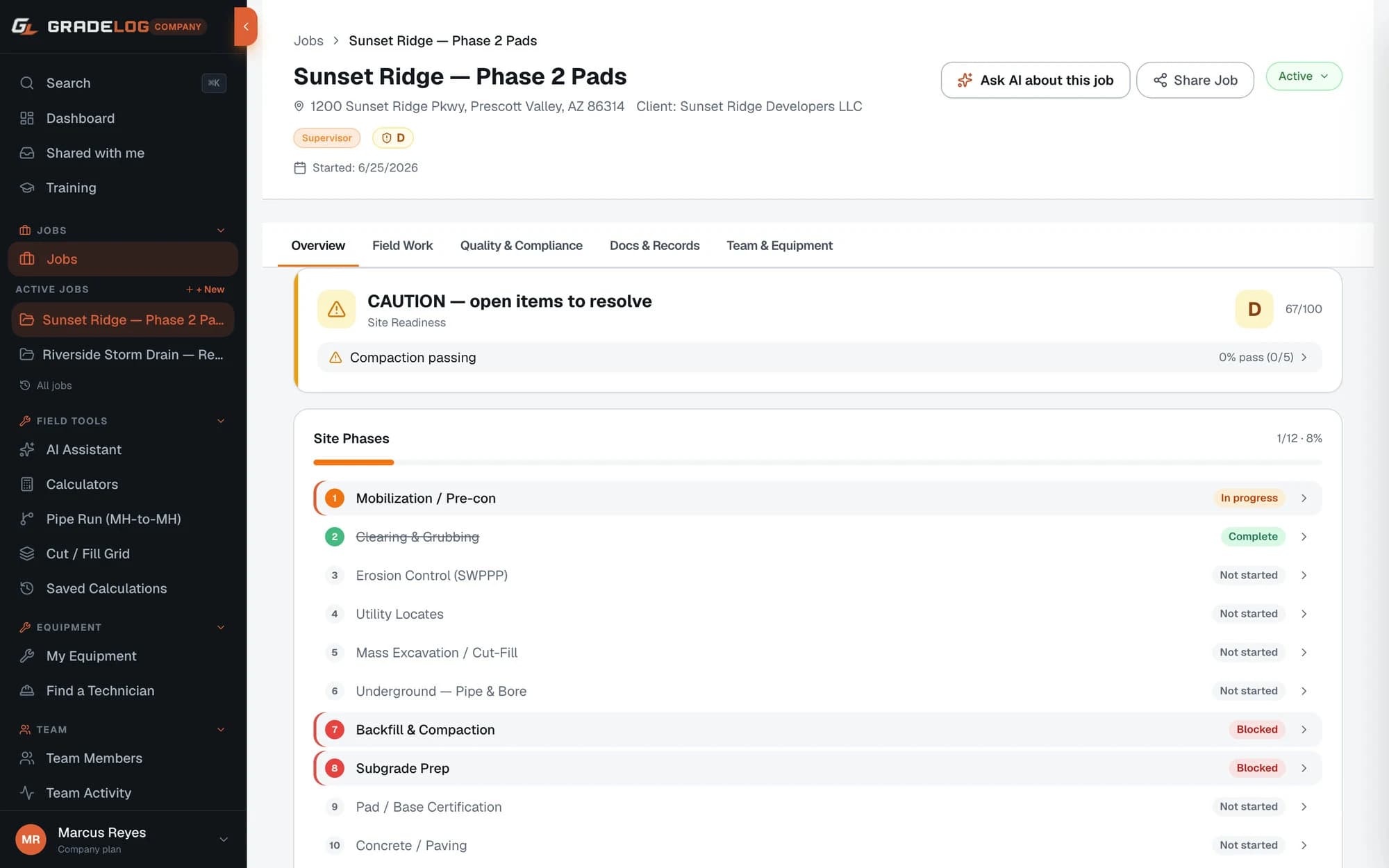
- Pass/fail auto-calculated against configured required percentage
AASHTO and ASTM formatted reports
- Report lists tests by station and lift in order
- Proctor reference shown with each result
- Failing tests highlighted for corrective action
- PDF export formatted for DOT inspector review
Per-lift and per-material tracking
- Track subbase, base course, embankment, and select fill separately
- Lift number per test for multi-lift documentation
- Overall pass rate per material layer
- Easy filter by lift or station range
Share with DOT inspector
- Share report via link — inspector opens it in any browser
- They download PDF and approve or reject digitally
- Approval timestamped in your Gradelog job
- No inspector account required
How it works
01
Set up the compaction log
Enter the Proctor reference (max dry density and optimum moisture from your test report) and configure the required compaction percentage for each material layer per your DOT spec.
02
Log tests as the gauge runs
After each nuclear gauge reading, enter the result in Gradelog. Pass/fail is calculated instantly — failing tests are flagged for rework before moving on.
03
Document rework and retest
If a test fails, note the corrective action (additional compaction passes) and retest. Document the retest result. The log shows the full history.
04
Submit the compaction report
Generate the Compaction Test Report and share the link with your DOT inspector or materials engineer. They review, download the PDF, and approve digitally.
Common questions
What compaction percentage does DOT require for road subbase?
DOT compaction requirements vary by state and specification layer. Typical requirements are 95% of maximum dry density (AASHTO T-99 standard Proctor) for subbase, 95–98% for base course, and 92–95% for select material or embankment. Federal-aid highway projects generally reference AASHTO standards. Gradelog lets you configure the required compaction percentage per lift and material type for your specific DOT spec.
How does nuclear gauge compaction documentation work in Gradelog?
Enter the nuclear gauge test results (wet density, dry density, moisture content, and percent compaction) along with station number, lift number, and material type. Gradelog compares your result against the Proctor reference value and flags pass or fail. The complete test log — including station, lift, result, and pass/fail — exports as a PDF formatted for DOT inspector review.
What does a DOT compaction test report include?
A DOT compaction test report includes: project name and number, date and station range, material type and specification reference, Proctor test reference (standard or modified, and maximum dry density), test results for each station (dry density, moisture content, percent compaction), pass/fail status, and the QC technician's name. Gradelog's Compaction Test Report template includes all of these fields.
Can I document compaction tests offline on a remote highway project?
Yes. Gradelog is offline-first. Road projects often span miles with no reliable cellular coverage. Technicians log nuclear gauge test results offline all day and data syncs automatically when connectivity is available. No results are lost and no duplicates are created on sync.